100 Claude AI Prompts for BTech Students | Projects, Placements, Coding & Exams
Skip to content
NSS Visuals

100 Practical Prompts for B.Tech Students

Stop Getting Generic AI Answers. Start With Prompts Built for Your B.Tech Journey.

Use 100 practical, copy-ready Claude prompts for projects, placements, coding and exams—with two examples and a quality check for every prompt.

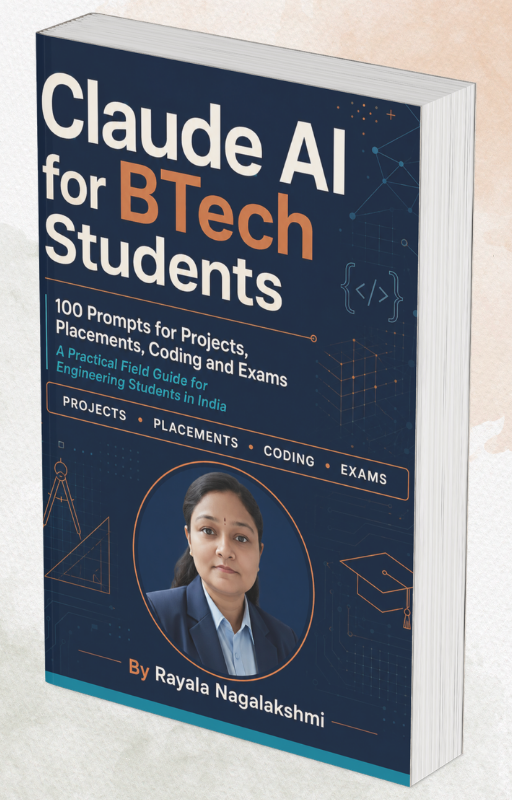
By Rayala Nagalakshmi

Get this eBook {{ priceLine }}

Digital PDF • Instant access after payment

  • 100copy-ready prompts
  • 200example inputs
  • 100quality checks
  • 30-dayaction plan
Cover of the eBook Claude AI for BTech Students: 100 Prompts for Projects, Placements, Coding and Exams by Rayala Nagalakshmi

The real problem

Better AI Results Start With Better Instructions

Most students do not get weak answers because the model is weak. They get weak answers because the request carries almost no information about their branch, syllabus, tools, deadline or marking rubric.

The request is vague

A three-word question cannot describe a six-month project or a 40-mark answer.

There is no context

Branch, year, lab access, current skills and syllabus scope are left out.

No real constraints

Budget, time per week, allowed tools and rubric limits never reach the prompt.

The first answer is accepted

No follow-up questions, no ranking of options, no request for trade-offs.

Facts go unverified

Equations, units, standards, citations and calculations are used as-is.

AI replaces the learning

Output gets submitted instead of being used to think, attempt and check.

Example 1 · Project ideas

Weak

"Give me final-year project ideas."

Stronger approach

State your branch, current skills, budget, project duration, available lab and tools, intended users, the real problem domain, your ranking criteria and an MVP requirement.

Example 2 · Concept study

Weak

"Explain DBMS."

Stronger approach

Name the exact concept, your current level, the course scope, the explanation depth you want, concrete examples, the misconceptions to correct, and retrieval questions you must answer first.

What's inside

One Playbook, Four Parts of Your Degree

A 114-page digital playbook that keeps every prompt structured the same way, so you always know what to fill in and how to check the answer.

114page digital playbook
100structured prompts
4focused categories
200example inputs
100quality checks
7-partprompt formula
6-stepResponsible Claude Workflow
30-dayBTech Action Plan
1Prompt Quality Checklist

The four parts

25 Prompts Each, Numbered 01–100

PROMPTS 01–25

Projects

From vague idea to validated problem, feasible scope, tested system, report, viva and portfolio proof.

  • Generate project ideas suited to your branch
  • Write a strong, testable problem statement
  • Run a feasibility study before committing
  • Define requirements and freeze an MVP scope
  • Compare architectures and technology stacks
  • Plan data collection, experiments and testing
  • Prepare reports, presentations and viva answers
  • Turn the project into a portfolio story

PROMPTS 26–50

Placements

Target roles intelligently, improve your evidence, practise interviews and manage applications.

  • Choose a realistic target role
  • Run a job-specific skills gap analysis
  • Improve your resume, LinkedIn and GitHub
  • Build self-introductions and STAR stories
  • Practise technical, HR and behavioural rounds
  • Prepare aptitude and group discussion
  • Research companies and decode job descriptions
  • Build a 30-day placement sprint

PROMPTS 51–75

Coding

Learn concepts, reason before coding, debug from evidence and build secure, maintainable systems.

  • Understand hard concepts at three levels
  • Convert requirements into pseudocode
  • Compare algorithms and complexity
  • Debug from evidence, not guesswork
  • Review, refactor and test your code
  • Run a secure code review
  • Design SQL queries, REST APIs and schemas
  • Build mini-projects in verified increments

PROMPTS 76–100

Exams

Convert syllabus into active learning through explanation, retrieval, spacing, problems and timed practice.

  • Turn a syllabus into an exam plan
  • Learn a topic with the Feynman method
  • Build active notes and formula sheets
  • Generate flashcards and retrieval quizzes
  • Practise numericals and master derivations
  • Analyse past papers responsibly
  • Prepare for laboratory vivas
  • Plan the final seven days before exams

The framework

The Seven-Part Prompt Formula

A prompt is not magic wording. It is a compact task brief. The formula makes sure Claude receives the information it needs to produce a useful, relevant and verifiable response—and that you can check the answer afterwards.

  1. 01

    Role

    Give Claude a relevant perspective: project mentor, interviewer, tutor, code reviewer.

  2. 02

    Context

    State branch, level, tools, constraints, syllabus, job description or system environment.

  3. 03

    Task

    Ask for one clear outcome: compare, diagnose, design, quiz, critique or plan.

  4. 04

    Inputs

    Paste verified material inside clear boundaries so the model works from real evidence.

  5. 05

    Constraints

    Specify time, budget, format, technology, policy, safety and what must not be invented.

  6. 06

    Output

    Request a usable structure: table, checklist, test plan, ranked options, one question at a time.

  7. 07

    Verification

    Require assumptions, uncertainties, sources, tests, units, limitations and a final quality check.

Sample Preview

See How a Prompt Is Built

Shortened previews only—every prompt in the eBook adds the full template, two example inputs and a quality check.

{{ sampleMeta }}

{{ sampleTitle }}

{{ sampleBody }}

Fill-in fields are shown in square brackets. The complete template, two worked example inputs and the quality check for this prompt are inside the eBook.

Why it works

More Than a Prompt List

Every one of the 100 entries is built to the same six-part structure, so a prompt teaches you how to brief a task—not just what to paste.

  • A clear purpose — what the prompt is actually for
  • A structured template with every field marked
  • Two example inputs from different branches
  • A quality check that tells you if the output is usable
  • Verification instructions for facts, units and code
  • Responsible-use boundaries for academic work

PROJECTS

The feasibility prompt makes you test time, skills, budget and lab access before you commit—instead of generating a list of impressive-sounding project titles.

CODING

The debugging prompt asks for evidence, a smallest reproducible case, tests and an explanation—so you can defend the fix, not just paste it.

Included in the book

The Responsible Claude Workflow

A six-step loop for every high-value task. You stay responsible for the final work, and the AI output becomes learning evidence you can show and defend.

  1. 01

    Prepare

    Collect the official syllabus, verified JD, code, measurements or project facts.

  2. 02

    Prompt

    Fill every relevant placeholder and remove the lines that do not apply.

  3. 03

    Question

    Answer the clarification questions and challenge hidden assumptions.

  4. 04

    Attempt

    Solve, write, code or explain it yourself first when learning is the goal.

  5. 05

    Verify

    Run tests, check sources, units, rules, citations, safety and real requirements.

  6. 06

    Reflect

    Record what you learned, errors found, evidence produced and the next action.

Included in the book

The 30-Day BTech Action Plan

You are not meant to run all 100 prompts at once. The plan sequences one project, placement preparation, coding practice and exam learning around a realistic schedule.

DAYS 1–7

Direction

Choose a real problem, validate assumptions, check feasibility, define requirements and freeze an MVP.

Projects 01–07

DAYS 8–14

Build

Clarify requirements, plan algorithms, implement small slices, debug, test, review and check security.

Coding 51–63

DAYS 15–21

Evidence

Run tests, analyse results, improve your README and portfolio, target a role, audit your resume.

Projects 17–25 + Placements 26–33

DAYS 22–30

Perform

Practise interviews and aptitude while using active recall, spaced review, problems and timed mock work.

Placements 34–50 + Exams 76–100

Minimum viable day: 60 minutes. 20 minutes of active recall or one timed problem, 20 minutes on a project deliverable, 15 minutes explaining an answer aloud, 5 minutes updating your error log. The book sets the routine—your results still depend on your own effort and verification.

Who it's for

Real Student Situations Covered

This is for you if

  • You are a B.Tech student in any engineering branch
  • You are using Claude for the first time
  • You are preparing a project, report or viva
  • Placement drives are approaching
  • You are learning programming and want to reason, not copy
  • You have semester exams to plan for
  • You keep getting generic AI answers
  • You want to use AI responsibly and stay within university rules

This may not be for you

  • You want shortcuts to dishonest academic submissions
  • You expect guaranteed marks or guaranteed employment
  • You are unwilling to verify AI-generated information
  • You plan to paste code you cannot explain
Portrait of Rayala Nagalakshmi, author of the eBook

About the Author

Rayala Nagalakshmi

NSS Visuals · Practical Student Series

Rayala Nagalakshmi is a WordPress Developer, Digital Marketer, and Entrepreneur with a Professional background. She specializes in website design, SEO, social media marketing, graphic design, affiliate marketing, and AI-powered digital solutions. Through her brands and projects, she helps businesses build a strong online presence and grow digitally.

Everything included

Get the Complete Playbook

  • 114-page digital PDF
  • 100 structured prompts
  • Four focused categories
  • 200 example inputs
  • 100 quality checks
  • Seven-part prompt formula
  • Responsible Claude Workflow
  • 30-Day BTech Action Plan
  • Prompt Quality Checklist
  • Instant access after payment
{{ priceDisplay }} Get this eBook

Digital PDF • Instant access after payment • For personal use only

FAQ

Questions, Answered Honestly

Is this eBook suitable for first-year students?

Yes. The prompts are beginner-friendly and you fill in your own year, branch and level. First-year students will use the exam, coding and concept prompts most; project and placement prompts become more useful later.

Can students from every engineering branch use it?

Yes. Every template asks for your branch, tools and constraints, so the same prompt adapts to CSE, ECE, EEE, Mechanical, Civil and other branches. The example inputs are drawn from different branches.

Do I need previous experience with Claude?

No. The book opens with how to use the prompts, the seven-part formula and the Responsible Claude Workflow, so you can start from your first session.

Does the eBook contain exactly 100 prompts?

Yes. The prompts are numbered 01 to 100: 25 for projects, 25 for placements, 25 for coding and 25 for exams.

Are examples included?

Every prompt includes two example inputs and a quality check—about 200 example inputs and 100 quality checks across the book.

Will it help with projects and placements?

It gives you structured prompts for project selection, feasibility, architecture, reports and viva, plus resume, LinkedIn, GitHub, interview and aptitude preparation. The outcome still depends on your own work, verification and practice.

Does it guarantee marks or a job?

No. No book, prompt or AI tool can guarantee marks, placement or interview outcomes. This is a study and preparation resource.

Can I submit Claude's answers directly?

No. The book is explicit about this: follow your university's rules and do not submit generated answers, code, reports or results as your independent work where that is prohibited. Use Claude to learn, question, practise, plan and critique your own work.

How will I receive the eBook?

After payment you are redirected to a download page where you can save the PDF immediately.

What format is the eBook?

A digital PDF of about 114 pages, readable on a phone, tablet, laptop or desktop. Second edition, August 2026.

What should I do if the download fails?

Try the download button again on a stable connection, or open the file in a desktop browser. If it still fails, email support with your payment reference and the file will be sent to you.

Is this an official Anthropic product?

No. This is an independent educational resource and is not affiliated with or endorsed by Anthropic, Claude, any university, company or recruiter. Product capabilities and policies can change—check current official documentation before relying on feature-specific instructions.

Whatever Comes Next—A Project, Interview, Coding Problem or Exam—Start With a Better Prompt.

100 copy-ready prompts, 200 example inputs, 100 quality checks and a 30-day plan, by Rayala Nagalakshmi.

Get this eBook

Digital PDF • Instant access after payment

Questions? {{ supportEmail }}

NSS Visuals

Practical Student Series

Claude AI for BTech Students · Second edition, August 2026

Policies

Contact

Author: Rayala Nagalakshmi

{{ supportEmail }}

This is an independent educational resource and is not affiliated with or endorsed by Anthropic, Claude, any university, company or recruiter.

© 2026 NSS Visuals · Rayala Nagalakshmi. All rights reserved.

100 Claude prompts for B.Tech

{{ priceLine }}

Get this eBook